Scientific & Regulatory Dossier — Physician Edition
The full 21-page dossier, including the source document index, the evidence hierarchy and the consolidated limitations section.
Open the dossier (PDF)Peer-Reviewed · Institutional · Government-Approved
Four decades of microbiological research, institutional clinical records, an indexed publication, patents and veterinary field data converge on one organism. This hub walks through each evidence stream in turn — tagged by type, with its limitations stated — so you can weigh it on its own merits.
Named researchers and named institutions are what make a historical record checkable. These are the people and bodies whose signatures appear on the primary documents.
The figure most consistently documented across the primary sources. Patent holder on both the 2004 Kazakhstan patent and the 2010 Eurasian patent, named on the production acts, and party to the 2019 commercial partnership with EnergyMax that led to current-scale production.
Authors of the two clinical-use instructions developed at the Alma-Ata State Medical Institute (AGMI) in 1993–1994 and approved by the Pharmacological Commission of the Ministry of Health. Their dosing protocols were reaffirmed in the 2013 ANGEK professional statement.
Co-author and signatory on multiple primary documents, including the 1985 production act and the KazNMU-adjacent research, carrying forward a line of inquiry into beneficial lactic-acid organisms described as beginning with Ivan Maximovich Ivanov.
Authors of the one independently indexed, peer-reviewed publication on the strain, conducted at the Kazakh National Medical University named after S. D. Asfendiyarov and published in Stomatologiia (Moskva) in 2000.
Almaty. Site of both the indexed 2000 publication and the published microbiological survey of dysbacteriosis patients, including the treated chronic-gastritis cohort described below.
Almaty. One of three institutions that recorded a physician-signed clinical act under the Ministry-approved protocol in 1994, alongside the Republican Polyclinic of the Military Medical Service and the Institute of Pediatrics.
Pichkhadze G.M., Rusanov V.P., Novoselov V.E. — Stomatologiia (Moskva). 2000;79(4):22–27. PMID 10961107. Verifiable by any physician outside anything supplied by the company or by Kazakh institutional archives.
The study examined strain 2585 lactic-acid bacteria against four clinically significant organisms isolated from patients with open mandibular fractures under active wound infection: Candida albicans, Pseudomonas aeruginosa, Staphylococcus aureus and Escherichia coli.
| Rank | Organism | Clinical relevance |
|---|---|---|
| 1 (strongest) | Candida albicans | Fungal wound colonisation — notably difficult to manage clinically |
| 2 | Pseudomonas aeruginosa | Common, often multidrug-resistant wound and hospital pathogen |
| 3 | Staphylococcus aureus | Leading wound-infection pathogen |
| 4 (weakest of the four) | Escherichia coli | Common wound and systemic pathogen |
"Use of the domestic eubiotic 'Maksilin' for correction of the microflora of the gastrointestinal tract" — Kazakh National Medical University, Almaty. A microbiological survey of 80 adults with clinically diagnosed dysbacteriosis, with a treated 30-person chronic-gastritis subgroup.
| Microbiological finding | At baseline (all 30) | After four weeks |
|---|---|---|
| Lactic-acid bacteria | None detected | ✓ Lactobacilli reappeared |
| Cellulolytic bacteria | None detected | ✓ Bifidobacteria reappeared |
| Lactose-negative E. coli | Present | ✓ Reduced lactose-negative coliform counts |
| Staphylococci | Present | Not separately re-assessed in the excerpt |
| Proteus | Present | Not separately re-assessed in the excerpt |
| Yeast-like Candida | Present | Not separately re-assessed in the excerpt |
| Stool character | Loose, foul-smelling | ✓ Normalised |
| Dyspeptic symptoms | Present | ✓ Resolved |
Between 1994 and 1995, three separate Almaty institutions treated three different populations under the same Ministry-approved protocol and recorded the same direction of change: reduction of lactose-negative coliforms and reappearance of bifidobacteria and acidophilic organisms.
General adult dysbacteriosis population, treated under the Ministry-approved protocol. Reported improved general condition and normalised digestion; reduced lactose-negative coliform counts with reappearance of bifidobacteria and acidophilic organisms. The act specifies no patient count, dosing or duration.
Women with genital infection and dysbacteriosis, treated by intravaginal application under bacteriological monitoring per Pharmacological Commission protocol No. 2 of 19 February 1994. Resolution of discharge, itching and mucosal inflammation; cervical mucus neutrophil function normalised by day 5–7; vaginal smears showed absence of putrefactive and pyogenic flora with Döderlein bacilli present post-treatment. Signed by Dr N. Poszdeeva (OB/GYN) and V. Kushtalova, with the official polyclinic seal. No control group or patient count is given in the act.
Children with intestinal dysbacteriosis, chronic colitis and secondary malabsorption, treated under bacteriological stool monitoring. Reported improved general condition and normalised digestion; reduced lactose-negative coliform counts and reappearance of bifidobacteria and acidophilus rods. The act specifies no patient count, dosing or duration.
Two clinical-use instructions for Maxilin were formally approved by the Pharmacological Commission of the Ministry of Health of the Republic of Kazakhstan, developed at the Alma-Ata State Medical Institute. A government body reviewed and stamped a specific dosing protocol — this is regulatory-record evidence, not company literature.
| Instruction | Approved | Dosing as recorded |
|---|---|---|
| Vaginitis / gynaecological use | 19 February 1994 | Intravaginal, 2–50 ml, or soaked tampons 2–3 hours per day; 5–10 day course. No stated contraindications. |
| Dysbacteriosis / gastrointestinal use, age-based | 1993 | Infants under 6 months 1–30 ml; 6–12 months 30–60 ml; 1–5 years 60–120 ml; over 5 years 120–200 ml; adults 200–400 ml, 1–2× daily, 10 days to 2+ months. No stated adverse effects at these doses. |
Earlier still, on 19 February 1993 the Pharmacological Commission registered the preparation — a pure culture of acidophilic bacteria, strain 2585 — as a natural medicine under Protocol No. 12.
In 2013 the Association of Nutritionists, Gastroenterologists and Endoscopists of Kazakhstan (ANGEK), chaired by Prof. E. A. Izatullaev, issued a professional statement describing Maxilin (culture 2585-1666) as indicated for gut-flora disturbances in post-cholecystectomy states, chronic pancreatitis, IBS, biliary dysfunction and hepatic steatosis. It reaffirmed the age-based dosing of 60–250 ml, one to three times daily, and is the most recent formal professional endorsement in the document set.
Döderlein bacilli — the lactobacilli that dominate a healthy vaginal microbiome — belong to the same genus as the organism in Maxilin. That is the biological reason the 1994 protocol existed, and the reason the gut and vaginal microbiomes are increasingly studied together.
The 1994 Republican Polyclinic act records vaginal smears showing Döderlein bacilli present after treatment where putrefactive and pyogenic flora had been found before it.
Neutrophil function in cervical mucus was recorded as normalised by day five to seven, alongside resolution of discharge, itching and mucosal inflammation.
The vaginitis and genital-infection instruction approved on 19 February 1994 set out intravaginal application of 2–50 ml, or soaked tampons for two to three hours daily, over a five to ten day course, with no stated contraindications.
The same lactobacilli genus populates both niches, and the intestinal reservoir is one route by which the vaginal microbiome is replenished. Restoring intestinal flora is therefore studied as part of the same picture rather than a separate one.
Veterinary field data cannot substitute for human clinical evidence. What it does provide is biological corroboration across species, in population sizes no human study of this product has matched.
Across 133,232 piglets, the historical field document reports approximately 1,277 fewer losses attributed to diarrhoea and dysbacteriosis after the strain-2585 preparation was introduced — roughly 1% of the total population — together with approximately 0.4 kg greater rearing weight per head.
The same complex used the preparation intrauterine across 500 sows to treat metritis, with acts reporting resolution of metritis signs by day three and oestrus resuming six to seven days after weaning. Those acts note it replaced antibiotic treatment, which had passed into piglets via milk and disrupted their resident flora. A 1982 toxicology screen found no pathogenicity in a mouse bioassay.
In two poultry houses affected by colibacillosis and coccidiosis, daily mortality of 300–350 birds fell to 40–100 birds after four days of Maxilin at 2 ml per kg of feed.
Scaled operation-wide at roughly 10 kg per tonne of feed for up to 40 days with no antibiotics required, the programme reported 4–5% improved bird survivability, 25–40% improved livestock survivability across applications, 1–1.5% improved egg-laying rate, stronger eggshells and a 2% economic gain above plan from October 2006. Kazakhstan's Nutrition Academy found treated-bird meat met high-quality, ecologically clean standards.
A fermented acidophilus preparation is not only a delivery vehicle for bacteria. The fermentation itself produces metabolites, and the historical documentation attributes part of the observed effect to them.
Lactic-acid fermentation lowers local pH and produces short-chain organic acids. The historical documentation attributes the preparation's antagonism toward putrefactive and pyogenic flora in part to this acidified environment, which opportunistic organisms tolerate poorly.
Lactobacilli synthesise B-group vitamins during fermentation, and the independent March 2025 Antigen analysis measured vitamin C at 67.6 mg per 100 ml by HPLC-DAD. The dry sachet includes vitamin C directly in its formulation.
The same analysis measured protein at 5.6 g per 100 ml of the liquid by GOST 30648.2-99, with the dry material reported at 31.89% protein. Fermentation partially pre-digests milk protein, which is the basis of the historical claims about amino-acid availability.
Potassium 362.8 mg and magnesium 194.2 mg per 100 ml, with zinc, iron and copper at 0.908, 0.129 and 0.024 mg respectively. The calcium figure in the source protocol is flagged for confirmation and is not used as a nutritional claim.
Each stream contributes something different, and each has a ceiling. Both are set out below exactly as the physician dossier states them.
| Tier | What exists | What it contributes | What it cannot establish |
|---|---|---|---|
| 1. Published research | 1 indexed paper (PMID 10961107) | Independently verifiable, peer-reviewed antagonism data | Clinical efficacy; gut-microbiome relevance |
| 2. Human clinical / institutional | KazNMU study; 3 institutional acts | Human outcome and microbiology data under real treatment | Randomised-trial-level proof; blinding |
| 3. Government / professional | 2 Ministry instructions; ANGEK 2013 statement | Regulatory-body-reviewed dosing and indication scope | Modern regulatory clearance (FDA / EMA) |
| 4. Laboratory validation | 2025 Antigen protocol; 2024 ATU report | Independent compositional and viable-count analysis | Efficacy; sachet-specific composition |
| 5. Patents / IP | Kazakhstan 2004; Eurasian 2010 | Novelty and intellectual-property protection | Clinical efficacy of any kind |
| 6. Veterinary field | Swine and poultry programmes | Cross-species biological corroboration | Human clinical proof |
| 7. Practitioner testimony | Physician accounts and one reported case | Clinical hypotheses; real-world signal | Controlled evidence of any kind |
| 8. Marketplace observation | Distributor feedback on the powder form | Early commercial signal | Any form of clinical or compositional equivalence |
Stated once, plainly: contemporary randomised, placebo-controlled, blinded human trials conducted on the current sachet formulation do not exist. That is the central evidence gap. The historical record is unusual not because every question has been answered, but because multiple independent streams converge on the same organism and the same reported behaviour — which is what makes the remaining questions worth asking.
Nothing on this page asks to be taken on trust. Both compilations are published in full, with the original Russian-language records reproduced alongside English translations.
The full 21-page dossier, including the source document index, the evidence hierarchy and the consolidated limitations section.
Open the dossier (PDF)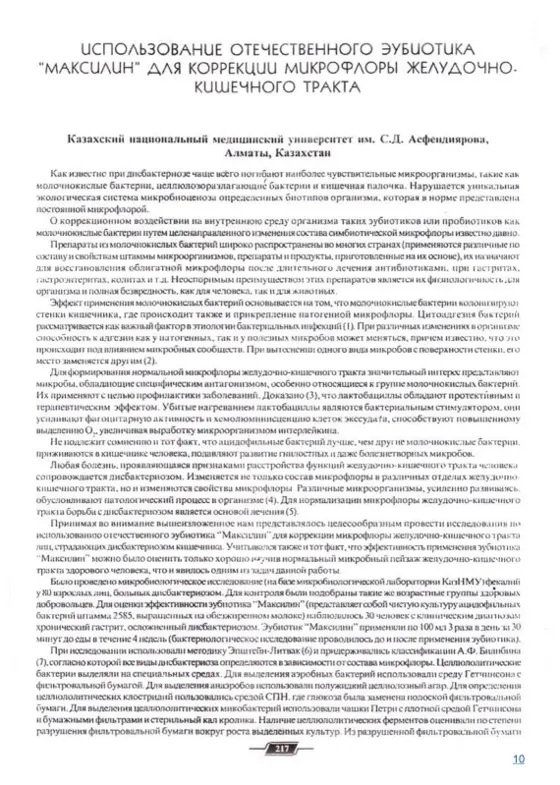
The published microbiological survey from the Kazakh National Medical University, reproduced with its English translation in the source document compilation.
Open the source documents (PDF)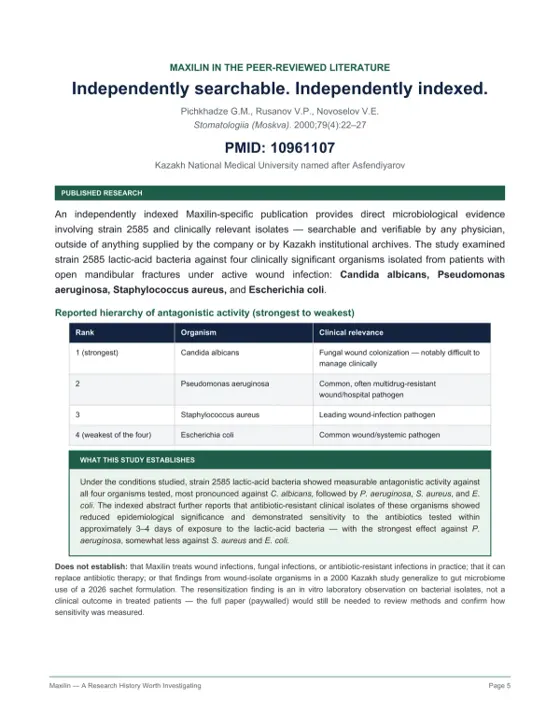
The reported hierarchy of antagonistic activity against C. albicans, P. aeruginosa, S. aureus and E. coli, with the scope of the finding set out explicitly.
View the record on PubMed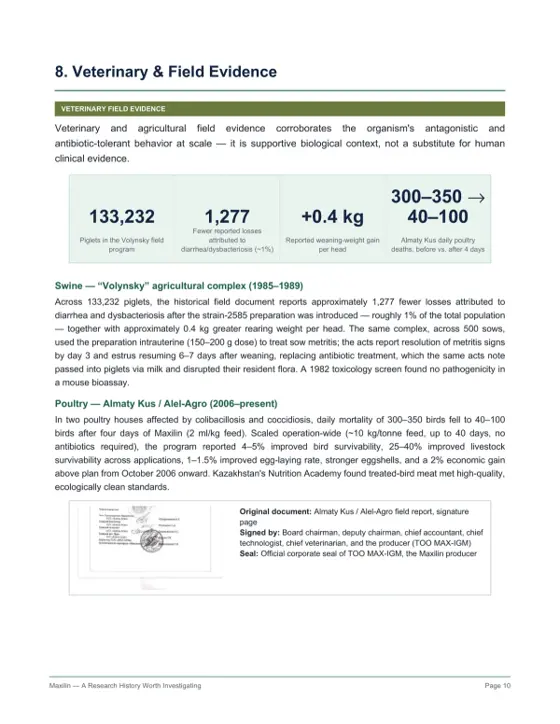
The swine and poultry field programmes, including the signed Almaty Kus and Alel-Agro report and the 1982 toxicology clearance.
Read the veterinary section