Strain Provenance · Manufacturing · Verified Testing

Why Maxilin Is Not Interchangeable With Other Probiotics

Most probiotics differ only by the label. Maxilin differs by the organism itself, by a patented production method, and by a documentary record that can be checked independently. Here is exactly what separates it — and what still needs to be studied.

2585
Patented acidophilus strain
014227 B1
Eurasian patent number
2
Formats — liquid and dry sachet
40+
Years of development and use

It Starts With Which Organism Is In The Sachet

A probiotic is only as specific as its strain designation. "Lactobacillus acidophilus" names a species containing thousands of distinct strains that behave differently. Maxilin names the strain.

A named, patented strain — not just a species

Maxilin is built on Lactobacillus acidophilus strain 2585, referenced in the source documents as culture 2585-1666. Strain-level identity is what allows a body of research to be attributed to one organism rather than to a species in general.

Protected in two patent jurisdictions

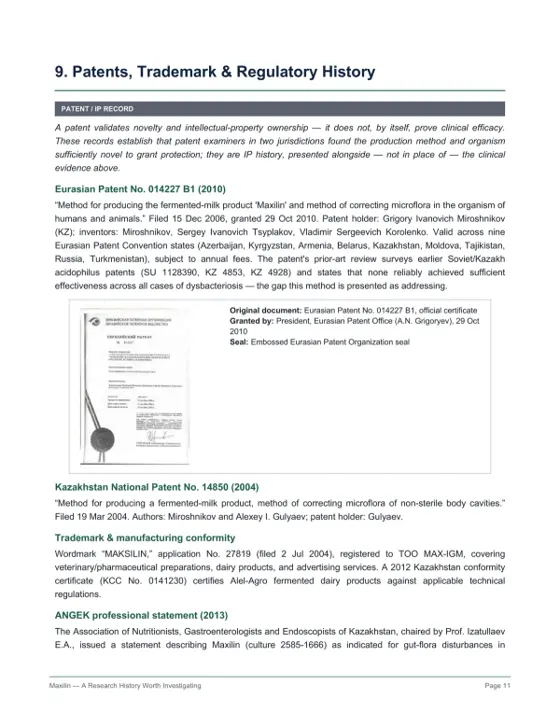
Eurasian Patent No. 014227 B1 — "Method for producing the fermented-milk product 'Maxilin' and method of correcting microflora in the organism of humans and animals" — was filed 15 December 2006 and granted 29 October 2010, valid across nine Eurasian convention states. Kazakhstan National Patent No. 14850 was filed 19 March 2004.

A patent establishes novelty and ownership. It does not, on its own, establish clinical efficacy — and it is presented here as intellectual-property history, not as proof of a health outcome.

A naturally occurring lineage

Company lineage material describes the original organism as isolated from lamb abomasum content and newborn meconium, rather than selected for ease of laboratory cultivation. This detail comes from company historical narrative rather than from a laboratory isolation record, and is presented as such.

Documented antibiotic tolerance

The 1993/1994 Ministry-approved clinical-use instructions describe strain 2585 as retaining viability and antagonistic activity under exposure to streptomycin, neomycin, monomycin, chloramphenicol (levomycetin) and gentamicin. Most probiotic organisms are themselves antibiotic-sensitive and are dosed away from an antibiotic course for that reason.

This describes a property of the organism. It is not evidence that Maxilin replaces antibiotics or treats antibiotic-resistant infection.

How The Dry Formulation Is Made — And Why It Survives The Stomach

Getting live bacteria into a sachet is straightforward. Keeping them alive on a shelf, and then alive through gastric acid, is the part most products lose. BIODEP addresses each of those two problems with a separate industrial step.

01

Lyophilization (freeze-drying)

BIODEP takes the live Lactobacillus acidophilus (strain 2585) culture after liquid fermentation and subjects it to rapid industrial freeze-drying. This process removes moisture under a vacuum, turning the liquid bacteria into a highly concentrated, shelf-stable dry powder without killing the live cells.

Because the water is drawn off as vapour directly from the frozen state, the cells are never exposed to the heat or the liquid-phase transition that would otherwise destroy them. The result is a dormant, viable culture that keeps without refrigeration.

02

Microencapsulation (coating)

Once dried, BIODEP applies its proprietary multi-layer embedded micro-coating technology (ProCap™) to the powder. This microscopic outer shield insulates the individual bacterial cells, ensuring they can withstand ambient moisture and survive the highly acidic passage through the human stomach.

Coating each cell individually — rather than coating a capsule that holds them — means the protection travels with the organism all the way to the intestine, which is where an acidophilus strain has to arrive intact to be of any use.

What this is: process information supplied by the manufacturer. The lyophilisation and ProCap™ microencapsulation steps describe how the dry product is made; they are not themselves a clinical finding, and viable-CFU survival through simulated gastric transit has not been independently assayed for the current sachet.

One Strain, Two Formulations

Strain 2585 is common to both forms, and the patented process and organism lineage connect them. The distinction matters when you read the evidence, because the historical record was generated on the liquid.

  Fermented liquid Dry sachet
Core organism L. acidophilus strain 2585 L. acidophilus strain 2585, 15 billion CFU
Additional organisms Single-strain preparation S. thermophilus 4 billion CFU; L. helveticus 1 billion CFU
Total viable count (label specification) Per batch; assayed at 20 billion CFU lactic-acid microorganisms, ATU Test Report No. 798 (2024) 20 billion CFU (company specification)
Also contains Fermented-milk matrix, inulin Resistant dextrin, inulin, vitamin C, lactase, vanillin
Stability Refrigerated, short shelf life Shelf-stable — lyophilised and ProCap™ microencapsulated
Where the historical evidence sits Sections 4–9 of the physician dossier were generated on this form Same foundational strain; independent identity, purity and viable-CFU testing of the sachet is the stated next step
Read the evidence carefully: the clinical and veterinary record described on this site was produced using the historical liquid formulation distributed in Eastern and CIS markets. The dry sachet carries the same core strain in a modern multi-organism format, but no laboratory protocol in the current document set has independently assayed viable CFU, identity or purity for the sachet.

Maxilin Against A Standard Shelf Probiotic

The comparison below is drawn from the documentary record rather than from marketing claims, and it is deliberately specific about where Maxilin's record is stronger and where it is not.

Point of difference Maxilin Typical commercial probiotic
Strain identified to strain level Strain 2585, named in patents and clinical records Often species-level only ("L. acidophilus")
Patent protection on the production method Eurasian 014227 B1; Kazakhstan 14850 Usually none
Behaviour under antibiotic exposure Tolerance documented in Ministry-approved instructions Typically antibiotic-sensitive; dosed apart from a course
Indexed, independently searchable publication PMID 10961107 (Stomatologiia, 2000) Varies; frequently none for the specific strain
Government-reviewed dosing protocol Two instructions approved by the Kazakh Ministry of Health Pharmacological Commission Manufacturer-set dosing
Independent compositional analysis Antigen Protocol No. FKh/26 (March 2025); ATU Test Report No. 798 (2024) Rarely published
Cross-species field corroboration Swine and poultry programmes at scale Not applicable
Randomised, placebo-controlled trial on the current formulation Does not yet exist — stated openly as the central evidence gap Occasionally exists for well-studied strains
Modern regulatory clearance (FDA / EMA) Not held; the product is a food supplement Not held

The Independent Analytical Data

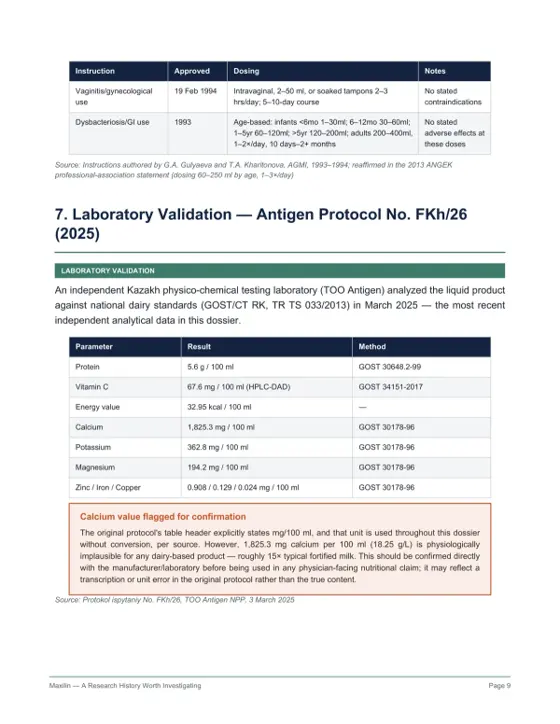
Two independent Kazakh laboratories have analysed the liquid product. Antigen NPP tested it against national dairy standards in March 2025; Almaty Technological University assayed viable count in 2024.

Parameter Result (per 100 ml, liquid) Method
Protein5.6 gGOST 30648.2-99
Vitamin C67.6 mg (HPLC-DAD)GOST 34151-2017
Energy value32.95 kcal
Potassium362.8 mgGOST 30178-96
Magnesium194.2 mgGOST 30178-96
Zinc / iron / copper0.908 / 0.129 / 0.024 mgGOST 30178-96
Calcium1,825.3 mg as recorded — see the note belowGOST 30178-96
Viable lactic-acid microorganisms20 billion CFU; zero coliformsATU Test Report No. 798 (Sep 2024)
Calcium figure flagged for confirmation: the original Antigen protocol states its values in mg per 100 ml, and that unit is reproduced here without conversion. However, 1,825.3 mg of calcium per 100 ml is roughly fifteen times the calcium content of typical fortified milk and is not physiologically plausible for a dairy-based product. The physician dossier flags this as a likely transcription or unit error in the source protocol. It is shown here for completeness and is deliberately not used anywhere on this site as a nutritional claim until it has been confirmed directly with the laboratory.

Download the primary documents

Both documents are published in full so that any clinician, retailer or researcher can read the underlying records rather than a summary of them.

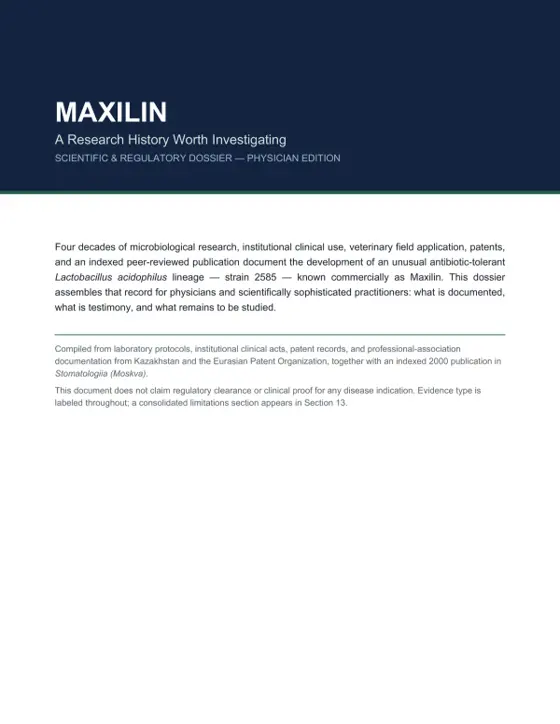
Cover page of the Maxilin scientific and regulatory dossier, physician edition

Scientific & Regulatory Dossier — Physician Edition

Twenty-one pages assembling four decades of microbiological research, institutional clinical records, patents and laboratory protocols. Every claim is tagged by evidence tier, and Section 13 sets out plainly what the record does not establish.

Open the dossier (PDF)
Cover page of the Maxilin historical source documents with English translations

Historical Source Documents & English Translations

Sixty-eight pages of the underlying archive — the KazNMU journal pages, the 1994 institutional clinical acts, the Ministry-approved clinical-use instructions, patent certificates and veterinary field reports — each reproduced alongside an English translation.

Open the source documents (PDF)
HPLC-DAD Vitamin C analysis for Maxilin liquid probiotic, Antigen Protocol No. FKh/26

HPLC-DAD Vitamin C Analysis — Antigen Protocol No. FKh/26

The March 2025 physico-chemical analysis of the liquid product against national dairy standards, including the 67.6 mg/100 ml vitamin C determination by HPLC-DAD.

Read the laboratory section
Eurasian Patent No. 014227 B1 certificate for the Maxilin strain 2585 production method

Eurasian Patent No. 014227 B1 & Trademark Record

The patent certificate granted by the Eurasian Patent Office on 29 October 2010, together with the Kazakhstan national patent, the MAKSILIN wordmark registration and the 2012 conformity certificate.

Read the patent section

What The Record Supports — And What It Does Not

Publishing the limits alongside the findings is the whole point of a document trail. The framework below is taken directly from the physician dossier.

Documented and defensible Requires qualification Not substantiated by these documents
Multi-decade research and institutional-use history Antibiotic tolerance — the organism survives antibiotic exposure Treating or curing cancer
Strain 2585 lineage, patented in two jurisdictions Whether the sachet delivers results equivalent to the liquid Curing serious or systemic infections
Human dysbacteriosis microbiological observations (KazNMU) Practitioner-reported outcomes — observational, not causal Replacing antibiotics
In vitro antagonistic activity under the conditions studied (Pichkhadze et al., 2000) "First" or "only in the world" phrasing — an unverifiable superlative Treating COVID-19 or other viral disease
Institutional clinical use under Ministry-approved instructions Historical military use — company narrative, uncorroborated Broad disease-treatment or universal-effectiveness claims
The central gap, stated plainly: contemporary randomised, placebo-controlled, blinded human trials conducted on the current sachet formulation do not exist. The historical record identifies the questions such a trial should answer; it does not answer them. See the research agenda that follows from it.

Want to read the records yourself?

Every document referenced on this page is published in full, and the clinical hub walks through each study and institutional act in detail.